


Employee Loyalty in Europe vs Australia: Key Differences
01 May, 2026
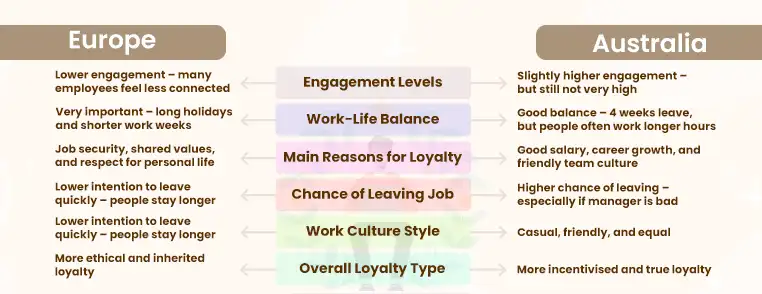
Employee Loyalty today is not just about how long someone stays in a company. It reflects how connected and engaged employees feel at work. Globally, only about 20% of employees are truly engaged, while nearly two-thirds are not fully engaged. At the same time, almost 30% of employees are actively looking for new job opportunities. When comparing Employee Loyalty in Europe and Employee Loyalty in Australia, two very different workplace cultures emerge. In Europe, employee loyalty is more stable due to - strong labor laws - structured systems - long-term benefits. In contrast, Employee Loyalty in Australia is driven by - flexibility - career growth - opportunity This contrast shows two clear models of Employee Loyalty Europe vs Australia. Europe follows a stability-based approach, while Australia follows a flexible, growth-driven approach. Many organizations today use an employee loyalty program or employee loyalty scheme to strengthen retention in both regions. Read more - What is an Employee Loyalty Program? Benefits & Uses Job security is one of the strongest drivers of Employee Loyalty. Employee Loyalty in Europe is supported by: - Strong labor laws - Structured termination policies - Union support - Long-term contracts These factors increase trust and long-term retention. Many companies also use an employee loyalty program and a staff loyalty program to reinforce stability. Employee Loyalty in Australia is more flexible: - Easy job switching - Skill-based hiring - Open job market - Performance-driven roles Employees focus more on growth than long-term tenure. This is why companies rely on employee reward programs for small business and staff loyalty rewards to retain talent. Employee Loyalty Europe vs Australia shows that Europe builds loyalty through security, while Australia builds it through opportunity. Work-life balance plays a major role in Employee Loyalty. - Fixed working hours - Long paid vacations - Strict overtime rules - Respect for personal time This structure strengthens Employee Loyalty in Europe. Companies often support this with a strong employee loyalty scheme and staff loyalty program. - Hybrid work options - Flexible hours - Output-based work - Informal schedules Flexibility boosts Employee Loyalty in Australia, even when employees switch jobs. Many firms introduce an employee loyalty program and staff loyalty rewards to maintain engagement. In Employee Loyalty Europe vs Australia, Europe ensures balance through rules, while Australia ensures it through flexibility. Career growth directly impacts Employee Loyalty. - Structured promotions - Clear hierarchy - Stable growth - Formal reviews This supports long-term Employee Loyalty in Europe, often backed by an employee loyalty scheme and staff loyalty program. - Faster job switching - Salary growth through movement - Skill development focus - Performance-based growth This defines Employee Loyalty in Australia, where companies depend on employee reward programs for small business and staff loyalty rewards to retain employees. Employee Loyalty Europe vs Australia highlights steady growth in Europe and fast growth in Australia. Read more - Top 5 fashion loyalty programs for employees in Europe Workplace culture shapes emotional Employee Loyalty. - Formal communication - Clear boundaries - Structured systems - Hierarchical setup This strengthens Employee Loyalty in Europe, often supported by an employee loyalty program and employee loyalty scheme. - Informal culture - Mateship values - Open communication - Relationship-based leadership This drives Employee Loyalty in Australia, where staff loyalty rewards and employee reward programs for small business play a key role. In Employee Loyalty Europe vs Australia, Europe builds loyalty through structure, while Australia builds it through relationships. Compensation strongly affects Employee Loyalty. - Stable salaries - Strong benefits - Pension security - Long-term protection These factors strengthen Employee Loyalty in Europe, supported by staff loyalty program and employee loyalty scheme initiatives. - Salary growth via job changes - Performance-based pay - Competitive market - Bonus-driven culture This drives Employee Loyalty in Australia, where employee reward programs for small business and staff loyalty rewards are widely used. Employee Loyalty Europe vs Australia shows Europe rewards stability, while Australia rewards performance. Read more - Top 5 fashion loyalty programs in Australia - Low turnover - Long tenure - Stable careers This reflects strong Employee Loyalty in Europe, often enhanced by an employee loyalty program and staff loyalty program. - High mobility - Frequent job changes - Boomerang employees This defines Employee Loyalty in Australia, where employee reward programs for small business and staff loyalty rewards help retain employees. Employee Loyalty Europe vs Australia shows stability vs movement. Driven by: - Job security - Legal protection - Structured growth - Long-term benefits This strengthens Employee Loyalty in Europe, supported by an employee loyalty scheme and staff loyalty program. Driven by: - Workplace pride - Strong relationships - Career opportunities - Flexibility This defines Employee Loyalty in Australia, where employee loyalty program, staff loyalty rewards, and employee reward programs for small business are essential. Employee Loyalty Europe vs Australia clearly shows two different approaches. Employee Loyalty in Europe is built on stability, structure, and long-term security. Employee Loyalty in Australia is built on flexibility, growth, and opportunity. Both systems rely on tools like employee loyalty program, employee loyalty scheme, staff loyalty program, and staff loyalty rewards to strengthen engagement. Additionally, employee reward programs for small business are becoming increasingly important across both regions. Ultimately, improving Employee Loyalty requires balancing stability with growth, no matter the geography.
1. Job Security and Employment Stability
Europe
Insight-
Australia
Insight:
2. Work-Life Balance
Europe
Insight:
Australia
Insight:
3. Career Growth and Progression
Europe
Insight:
Australia
Insight:
4. Workplace Culture and Relationships
Europe
Insight:
Australia
Insight:
5. Compensation and Motivation
Europe
Insight:
Australia
Insight:
6. Job Mobility and Turnover Trends
Europe
Insight:
Australia
Insight:
7. Overall Loyalty Models
Europe: Stability-Based Model
Insight:
Australia: Loyalty Paradox Model
Insight:
Conclusion